Tennessee Williams 4-Film Collection Blu-ray review
Mar 17, 2026- Permalink
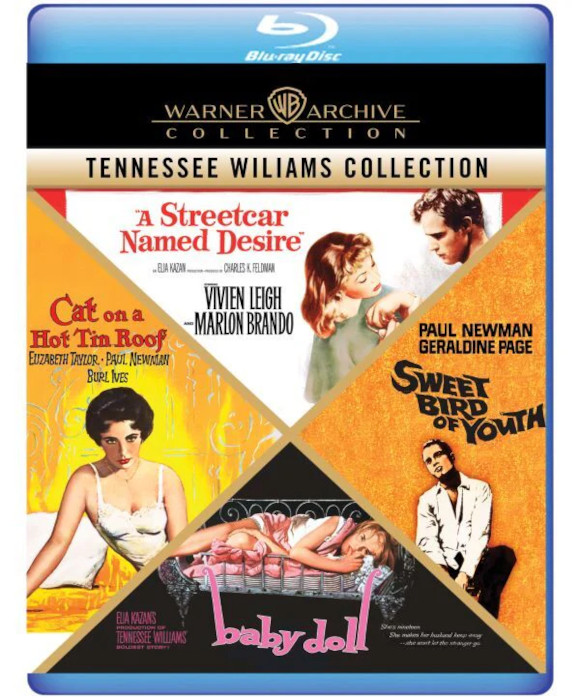
Warner Archive is releasing the Tennessee Williams 4-Film Collection Blu-ray. These collections are a great way to get a “starter pack” of an artist’s work. In this case, we get four films adapted from the works of legendary playwright Tennessee Williams: 1951’s A Streetcar Named Desire, 1956’s Baby Doll, 1958’s Cat on a Hot Tin Roof, and 1962’s Sweet Bird of Youth. Thanks to Allied Vaughn and Warner Archive, I had a chance to look at this release.
Released in 1951 and directed by Elia Kazan, A Streetcar Named Desire sees an aging Southern Belle, Blanche DuBois (Vivien Leigh), move into the tenement apartment of her sister, Stella (Kim Hunter), and her violent, brooding brother-in-law, Stanley Kowalski (Marlon Brando). Blanche claims she left her teaching job due to anxiety, but Stanley believes otherwise. Though Blanche begins a relationship with Stanley’s kind friend, Mitch (Karl Malden), Blanche and Stanley are on a collision course. Brando, Hunter and Malden all reprised their Broadway roles. This release contains three previously excised minutes. While the themes of mental illness and domestic violence could be explored in a play, the wider audience of film saw Kazan having to do a dance around the censors of the time.
The 1080p AVC encoded digital transfer is presented in a 1.37:1 aspect ratio. The video presentation is really nice. The clarity is there, though it can be a little soft at times. The real star here is the contrast. Kazan and cinematographer Harry Stradling play with light and dark, with the shadows perhaps reflecting what the characters are hiding from themselves and others.
On the audio side of things, you have the choice of an English DTS-HD Master Audio Mono soundtrack as well as French, German, Italian, Portuguese, and Spanish tracks. Subtitles are available for English SDH, French, German, Italian, Portuguese, Spanish, Croatian, Danish, Dutch, Finnish, Greek, Hebrew, Mandarin (Traditional), Norwegian, Romanian, Slovenian, and Swedish. The mono track is mixed well, with the dialogue taking centre stage and the score supporting the emotional heft of the story.
There is no digital code for this movie. We do get a commentary, hosted by Laurent Bouzereau, that includes Karl Malden and film historians Rudy Behlmer and Jeff Young. There’s “Elia Kazan: A Director’s Journey”, a 60+ minute doc hosted by Eli Wallach. Kazan had controversy in his past (read about his testimony to the House Un-American Activities Committee) and this piece does sort of step around that a bit. “A Streetcar on Broadway” has commentary on the play by Kazan, “A Streetcar in Hollywood” has Kazan talking about the adaptation, “Censorship and Desire” sees historian Rudy Behlmer talking about the difficult path getting the film made, “North and the Music of the South” is a profile on composer Alex North. Next is “An Actor Named Brando” and I’ll let you guess who that profiles. We also get a screen test of Brando, outtakes, audio outtakes, and multiple trailers.
1956’s Baby Doll is based on two of Williams’ one-act plays: The Unsatisfactory Supper and 27 Wagons Full of Cotton. A black comedy, it tells the tale of “Baby Doll” Meighan (Carroll Baker), a child-bride in a negotiated marriage with Archie Lee Meighan (Karl Malden), a bigoted owner of a failing cotton gin, who is eagerly awaiting his 19-year-old bride’s 20th birthday. That’s the day, stipulated in the marriage agreement, when he can finally consummate his marriage and he’s been counting down now for two years. Meighan also finds himself at odds with Silva Vacarro (Eli Wallach in his film debut), a Sicilian-American with a profitable cotton gin business. Baby Doll received both praise and condemantion. Reviews were mostly positive and it received multiple nominations from the Academy Awards, the Golden Globes and BAFTAs. Wallach received a Most Promising Newcomer BAFTA, while Kazan and Baker won Best Director and New Star of the Year Golden Globes respectively. However, some religious leaders urged parishiners not to see the film and the Catholic Legion of Decency rated it “C” for “Condemned.” The film was banned in several countries.
The 1080p AVC encoded digital transfer is presented in a 1.85:1 aspect ratio. The video presentation is beautifully clear, with great detail in faces, textiles, and settings. There’s only a few occasional moments of softness. The remastered transfer has deep black levels and a natural film grain. Warner Archive’s transfers are always impressive and this one is no different.
On the audio side of things, there’s an English DTS-HD Master Audio 2.0 Mono soundtrack. Subtitles are available for English SDH. Dialogue is clear in the mix and there’s only some occasional hiss and crackle to speak of.
Baby Doll does not come with a digital code. We get a theatrical trailer and “See No Evil”, a featurette that includes interviews with Malden, Baker, and Wallach where they talk about the reception of the film in the context of other events of the time.
The third highest-grossing film of 1958, Cat on a Hot Tin Roof was directed by Richard Brooks and stars Elizabeth Taylor, Paul Newman, Burl Ives, Jack Carson, and Judith Anderson. While celebrating Big Daddy Pollitt’s 65th birthday, it’s decided to keep a medical diagnosis away from him. Big Daddy (Burl Ives), meanwhile, is trying to exert control over his sons and his estate. Eldest son Gooper (Jack Carson), is a successful attorney, but the favourite son is Brick (Paul Newman), a former football star with a drinking problem and a wife, Maggie (Elizabeth Taylor), that he refuses to sleep with. The Hays Code, Hollywood’s self-imposed moral guidelines that loomed over most productions from 1934 to 1968, puts its nose firmly into Cat on a Hot Tin Roof. If you’ve seen the play, then the version in Brooks and James Poe’s screenplay has been sanitized. While theatre audiences could handle Williams’ play exploring themes of homosexuality, it was felt that movie audiences couldn’t, especially when the leads were Newman and Taylor. If you’ve seen the play, you have to view the film version within this bubble.
The 1080p AVC encoded digital transfer is presented in a 1.78:1 aspect ratio. Warner Archive’s transfer is from a 2K scan and it’s gorgeous. Facial features, hair, clothing and sets are sharp and detailed. The colours look great here and we could probably write a book just on the colour of Newman and Taylor’s eyes. Black levels are deep with details in shadows and reflections off of brass are bright. There’s a natural film grain and no sign of digital noise and compression artifacts.
On the audio side of things, you have the choice of an English DTS-HD Master Audio 2.0 Mono soundtrack as well as French, German, Spanish (Latin American and Castillian), Czech and Polish Dolby Digital 2.0 Mono tracks. Subtitles are available for English SDH, French, German SDH, Japanese, Spanish, Czech, Korean, Polish, Romanian, and Turkish. The all-important dialogue is clear and prioritized in the mix, while the score support the emotional beats of the story.
There is no digital code. There’s an audio commentary by Donald Spoto, who wrote biographies of both Williams and Taylor, “Cat on a Hot Tin Roof: Playing Cat and Mouse” a piece narrated by Ashley Judd that looks at Newman, Taylor and the film’s place in their careers, and finally, a theatrical trailer.
The final film in the collection is 1962’s Sweet Bird of Youth, again directed by Richard Brooks. Chance Wayne (Paul Newman) is a chauffeur and gigolo to an older film star, Alexandra Del Lago (Geraldine Page). She feels her star is fading and travels with him to his hometown in Mississippi, where he’s reunited with the corrupt politician, Tom “Boss” Finley (Ed Begley), Finley’s ruthless son, Tom Jr. (Rip Torn), and the girl he left behind on his own way to seek stardom, Heavenly Finley. Like Cat on a Hot Tin Roof, some elements of the stage production were changed for the screen, but not as much as happened with Cat on a Hot Tin Roof. In just a few years, the Hays Code’s sway over the studios would be gone.
The 1080p AVC encoded digital transfer is presented in a 2.35:1 aspect ratio. It’s another beautiful looking transfer with crisp detail. The colour palette is more muted here with earthy tones and rich greens though there’s the occasional pop of red. Black levels are deep and whites are crisp and highlights off of glass and chrome shine. There’s a subtle grain structure and no real signs of digital noise and compression artifacts.
On the audio side of things, there’s a sole English DTS-HD Master Audio 2.0 Mono soundtrack with subtitles available for English SDH. Again, dialogue is all-important in a Williams’ play and it’s clear and prioritized in the mix.
There is no digital code. In terms of extras, we get the theatrical trailer, a featurette called “Sweet Bird of Youth: Chasing Time” which discusses the stage version and its adaptation, and a screen test with Page and Torn, who plays Newman’s role in the test footage. A little trivia: Torn and Page were married the year after this film and remained so until her death in 1987.
The Tennessee Williams 4-Film Collection Blu-ray gives packages together four the the legendary playwrights works. Amazing casts, excellent audio and video, a nice selection of extras. What’s not to like? Recommended.