Evans Above
I think the technical term for this is EGADS! Please be patient as we curse and yell at a database mixup that deep sixed dozens of our database entries. We need to clean up or recreate them one by one. Should be fun...
Sep 10, 2019
Aladdin Signature Collection Blu-ray review
Disney has now re-released its classic and iconic animated feature Aladdin as part of its Signature Collection. I had a chance to review the Blu-ray/DVD/Digital combo pack.
The main change to the 1080p AVC-encoded transfer is its aspect ratio. The previous home releases were in a 1.85:1 aspect ratio, while this Signature Collection release is now in the cinematic version’s 1.66:1 aspect ratio. Other than that change, the video presentation is near identical to the Diamond Blu-ray edition. The transfer is, in a word, gorgeous. There are some digital artifacts and colour banding but they don’t detract from the dazzling colour palette, the inky blacks and excellent contrast. As I said in my review of the Diamond Blu-ray “If you asked a genie for one wish regarding the video presentation, he’d deliver this.”
The audio is also the same as the Diamond release. Your ears will be treated to an English DTS-HD Master Audio 7.1 soundtrack and French and Spanish Dolby Digital 5.1 tracks. Subtitles are available in English SDH, French and Spanish. To reiterate my comments on the audio you’ll find the songs and action are well-served by the surround speakers and the low frequency output gives a firm floor to every joke and musical number. The dialogue is very clean and intelligible, which is so necessary to keep up with Robin Williams’ lightning-fast ad libs. It’s an excellent audio presentation.
The main change you see with most Signature Collections is in the extras. There are some new ones and others that have been removed or migrated to digital only. New extras include Aladdin voice actor Scott Weinger reconnecting with people involved with the production to talk about the movie and catch up. There also a new look at the voice recording sessions, a look at the digital-only extras and some alternate endings. You can sing-along with the movie, a look at the Broadway show, audio commentary from the producers and audio commentary. Digital-only extras include a look at composer Alan Menken, a look at Supervising Animator Eric Goldberg as he discusses his work and draws the Genie, the theatrical trailer, deleted scenes, music videos from Clay Aiken, Jessica Simpson and Nick Lachey, and many more behind-the-scenes looks.
As with many of the Signature Collection releases, it boils down to extras. If you don’t own the Diamond Edition of Aladdin, then the Signature Collection is for you and you’ll want to add it to your collection, giving you the original aspect ratio, and excellent video and audio presentations. If you do have the Diamond Edition, then the main change is the aspect ratio and some slight changes in extras.
Sep 09, 2019
John Wick: Chapter 3 — Parabellum Blu-ray review
They say death and taxes are the only sure things, but I’m thinking that when you’re a semi-retired hitman who does an unsanctioned kill of a crime lord who is part of a mysterious syndicate you can be sure that there will be attempts at retribution. That’s exactly where John Wick (Keanu Reeves) finds himself at the beginning of John Wick: Chapter 3 — Parabellum. With a legion of assassins hoping to cash in on the $14 million bounty on his head, Wick needs to fight back and the audience knows that they’re in for a thrill ride. Those thrills can now be taken home with Lionsgate’s home entertainment release. I had a chance to review the Blu-ray/DVD/Digital combo pack.
The 1080p AVC-encoded transfer is in a 2.39:1 aspect ratio. Shot digitally with Arri Alexa cameras, this digital transfer is pretty amazing. A lot of this movie’s scenes take place in dark and stormy locations and so you’d expect it to have good depth in the black levels and you won’t be disappointed. There is only the occasional loss of detail in the shadows and you can put your stationery away because it’s nothing to write home about. The colour palette is infused with a lot of purple and blues. Brighter scenes have amazing detail.
On the audio side of things, your ears have the choice of English Dolby Atmos and Dolby TrueHD 7.1 soundtracks as well as a Dolby Digital 2.0 track optimized for late night listening a.k.a. not waking the neighbours up during the chases and battles. There are also French and Spanish Dolby Digital 5.1 tracks. Subtitles are available in English, English SDH, French and Spanish. Those with an Atmos setup will notice that this soundtrack makes good use of the height elements, while the other surround speakers are given quite the workout too. This soundscape will surround you with so much ambient detail that you may find yourself desiring an umbrella and a firearm. Your subwoofer will also clock in a workout during the many bone and metal crunching battles. Dialogue is clear and centred.
On the extras side, the Blu-ray also comes with a DVD copy and a digital code. There’s a decent collection of cast and crew interview and behind-the-scenes featurettes, theatrical trailers, and looks at the John Wick: Hex game.
If you’re a fan of quaint, quiet films where people discuss their feelings in pastoral settings then John Wick: Chapter 3 — Parabellum may not be for you. If you like to sit on the edge of your seat for heart-pounding action scenes with excellent video and audio presentations, then this Blu-ray is right up your blood and rain soaked alley. You’ll want to add it to your home entertainment collection.
Aug 27, 2019
The Secret Life of Pets 2 Blu-ray review
In The Secret Life of Pets 2, our furry pals find themselves facing new challenges and adventures the moment we leave them to their own devices. Max and his pal, Duke, must deal with their owner’s new toddler while negotiating a vacation on a farm. Gidget must rescue a toy entrusted to her by Max from a house overrun by cats. And the over-confident rabbit, Snowball, dreams of being a superhero and tries to make those dreams a reality when he helps a Shih Tzu rescue a white tiger cub from an abusive circus owner. All of these hijinks can be yours as Universal now has them available for your home entertainment library. I was able to review the Blu-ray, DVD, digital download combo pack.
The AVC-encoded 1080p transfer is in the theatrical release’s original 1.85:1 aspect ratio. This computer-animated film’s video transfer is gorgeous. The colour palette just pops off the screen, whether it be bold primaries or all the shades inbetween. Textures are amazing too, from the fur details on our animal friends to environmental elements from rural farm to big city. Contrast is good and the black levels nice and deep. No evidence of banding or noise. This video presentation gets an A+, a star sticker, and no final exam.
On the audio side of things, you’ll find English Dolby Atmos and Dolby TrueHD 7.1 soundtracks as well as Spanish and French Dolby Digital Plus 7.1 tracks. Subtitles are available in English SDH, French and Spanish. The audio presentation saw how well the video side was doing and rose to the occasion. The Atmos track makes good use of the height speakers, the surround speakers put you in the middle of the madness, and the low-frequency elements, from bass music to moving cows, hits with the right power. Music is bright and dynamic, while dialogue is clear and centred.
The combo pack I reviewed also came with a DVD version of the movie as well as a Movies Anywhere digital download code. Two mini-movies, Super Gidget and Minion Scouts, are joined by an impressive array of extras, including a look at the making of the aforementioned shorts. We get deleted scenes, a look at the process of editing and voice acting, a lesson in how to draw three of the characters, a lesson in making flip book animations, the actors talking about their characters, a look at cast and crew with their pets, a choose your own adventure sort of piece featuring Snowball, a short doc on service animals, instruction on how to throw a pet party, a lesson on massaging your pet, a look at Kevin Hart trying to train a puppy, and two karaoke style videos.
With excellent video and audio presentations, a plethora of extras and a fun story for the family, you’ll want to add The Secret Life of Pets 2 to your home entertainment library.
Aug 13, 2019
Avengers: Endgame Blu-ray review
If you’re one of the handful of people on the planet who didn’t see Avengers: Endgame during its theatrical release, I’ll refrain from saying much about the film except to say that this latest installment of the Avengers story took the audience on an action-packed emotional rollercoaster five years after Thanos destroyed half of the life in the galaxy at the end of Avengers: Infinity War. This epic tale is now available to enjoy at home. I had the chance to review the Blu-ray version, which also comes with a digital download code.
The 1080p AVC-encoded transfer is presented in the theatrical release’s 2.39:1 aspect ratio. The video presentation is quite flawless, with no discernible noise or encoding artifacts. The real and CGI elements blend well and detail and clarity — whether we’re talking about textiles, surfaces, facial features or natural environments — is excellent. Black levels are great, low-light scenes have detail and the colour palette across environments and superhero costumes is pleasing. It’s just an all around great presentation.
Moving on to audio, the disc comes with an English DTS-HD Master Audio 7.1 sound track as well as French and Spanish Dolby Digital 5.1 tracks. Subtitles are available in English SDH, French and Spanish. Those looking for a Dolby Atmos soundtrack will have to look at getting the 4K release of the film. Unlike many recent Disney releases, this one plays well at reference volume levels and doesn’t need a volume boost to show off its full dynamics. As you’d expect, the soundscape makes full use of your surround speakers and places you in the centre of the action. The low-end frequencies give oomph where oomph is needed. Music is nicely presented and dialogue is clear and centred in the mix. An excellent audio presentation.
The presentation contains so many extras that a second disc just of extra material is included. The first disc contains audio commentary by directors Anthony and Joe Russo and writers Christopher Markus and Stephen McFeely, as well as an introduction by the two directors. The second disc includes a tribute to the late, great Stan Lee, a look at Robert Downey Jr.’s work in the MCU, explorations of the characters of Captain America and Black Widow, a look at the Russo Brothers’ work on several of the MCU films, a look at the Women of the MCU, an exploration of Thor’s character arc, deleted scenes, and a gag reel.
Fans of the Marvel Cinematic Universe will definitely want Avengers: Endgame in their collection. With a thrilling, emotional story, great video and audio, and a good amount of extras, you’ll want this one in your home entertainment library.
Jun 27, 2019
Game of Thrones: The Complete Collection available in a Premium Blu-ray Set on December 3rd
If you or a family member are lamenting the end of Game of Thrones, fear not, as Game of Thrones: The Complete Collection will hit store shelves on December 3rd, 2019.
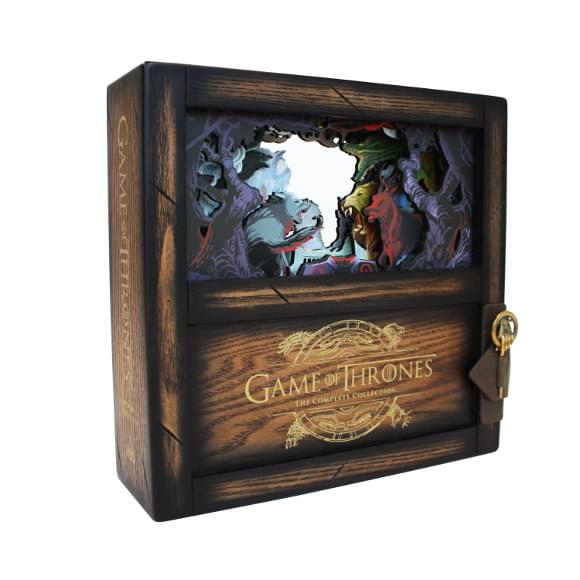
Game of Thrones: The Complete Collection limited-edition collectible set
Avid collectors will want this premium version, a limited-edition set packaged in a wooden shadow box case, featuring beautiful, multi-layered panel designs by Robert Ball that summarize the Game of Thrones story. Each season is represented by a different layer, showcasing iconic characters and memorable moments from the show, all clambering toward the Iron Throne. The set also contains a “Hand of the King” pin clasp, which holds all nine custom plated disc sleeves.
This premium edition’s Blu-rays also feature an exclusive two-part Game of Thrones: Reunion Special hosted by Conan O’Brien. Shot in Belfast in front of an audience, the special features cast members from the final season including Kit Harington, Emilia Clarke, Sophie Turner and more, as well as previously departed fan-favorites like Sean Bean, Jason Momoa, Mark Addy and others.
Additional bonus content includes all-new deleted and extended scenes, animated histories and lore pieces, fascinating behind-the-scene featurettes, audio commentaries and the documentary featured on DVD in two parts, Game of Thrones: The Last Watch, by filmmaker Jeanie Finlay.
HBO will also release Game of Thrones: Season 8 in a stunning 4K Ultra HD and Blu-ray Steelbook, and the single season DVD/Blu-ray. Additionally, Game of Thrones: The Complete Series will also be available on DVD/Blu-ray without the collectible packaging. These sets are loaded with extra content and will also be available to own on December 3rd.
Please note, fire-breathing dragons are not included. They kept melting the Blu-rays.
Jun 22, 2019
Cinderella Signature Collection Blu-ray review
Cinderella, Disney’s 1950 animated classic, is now the ninth film to be given the Signature Collection treatment. I had a chance to look at the Blu-ray/DVD/Digital combo. As with most other Signature Collection releases, the video and audio presentation is the same as the previously released Diamond Edition. The difference lies in the extras, which includes some new content and removes some others.
The AVC-encoded 1080p transfer is in a 1.33:1 aspect ratio, just slightly different from the theatrical release’s 1.37:1 ratio. Film purists might notice the pretty complete removal of film grain, but this is probably necessitated by a modern audience used to digital-to-digital transfers. It’s a beautiful transfer. The colour palette is attractive, whether presenting the pop of primary colours or the subtlety of pastel hues. Contrast and sharpness are on point. The edges of the animated line art are crisp and the beautifully painted backgrounds this era of Disney is known for couldn’t look more gorgeous. There really aren’t issues with digital banding or artifacting either. To put it simply, it’s a presentation worthy of Disney’s talented cel animators.
On the audio side of things, we get an English DTS-HD Master Audio 7.1 soundtrack, an English DTS-HD Master Audio Mono track and French and Spanish Dolby Digital 5.1 tracks. Subtitles are available in English SDH, French and Spanish. Film purists will be happy that this release comes with DTS-HD Master Audio version of the movie’s original mono audio mix. Dialogue, music and effects all are clean and crisp despite being in the same mix. Those who want their surround sound to get a bit of a workout will be happy that the team at Disney also gives them a 7.1 surround track and manage to put a 1950 soundtrack into an ambient soundscape.
So, on to the extras, which is where this set differs from the previous Diamond Edition. First off, a DVD version of the disc is included as well as a Movies Anywhere digital code. There are two new extras: an audio commentary comprised of archival discussions by Walt that also features picture-in-picture storyboards and artwork and a short trivia presentation hosted by Ruth Righi and Ava Koelker from Disney’s Sydney to the Max. Removed from the previous edition are extras like a personalized digital storybook called Bibbidi-Bobbidi-You, Tangled Ever After, deleted scenes, a look at songs that didn’t make the cut, a tutorial on digital copies and a look at 3D Blu-ray’s with Timon and Pumbaa from The Lion King. Losing these is probably not a big deal. Legacy extras that did make it to the disc include an intro from Diane Disney Miller, a 38 minute making of doc, an alternate opening sequence, a series of featurettes on the animators, storyboards, theatrical trailers, a look at Fantasyland and clips from the Mickey Mouse Club. A handful of other extras are available online.
If you own the Diamond edition, you may want this one in order to get the “commentary” extra with Walt and the storyboards. If you don’t own the previous Diamond Edition, then you will want this version as to call Cinderella an animated classic is an understatement and the film is a must have for lovers of the genre and Disney.
Tim Burton’s live action Dumbo Blu-ray review
Depending on your point of view, Disney is either looking for ways to revisit its animated classics with live action remakes or plundering its past to try and make new money off of old and tested material. With Dumbo, Disney heads back to the 1941 tale of a baby circus elephant who can fly. This time the ringmaster is Tim Burton, who brings his trademark style to the visuals in this story. You can now take it home. We had the chance to check out the Blu-ray/DVD/Digital combo set. A 4K version is also available.
The AVC-encoded 1080p transfer is in the theatrical release’s 1.85:1 aspect ratio. Shot digitally, the video presentation is full of crisp, sharp details. The period costumes look amazing, from the textures of the textiles, to the detail of the stitching. The environmental details also look great, whether it be the hay on the ground to the circus tent soaring above the action. The faces of the actors are equally sharp and detailed, as are the elephants and other CGI-created effects. The circus is reflected in the colour pallete with strong hues and the black level is deep. Low light level scenes still hold detail. There is some digital noise throughout the film, especially in lower light scenes.
On the audio side, your ears have the choice of an English DTS-HD Master Audio 7.1 soundtrack or Spanish and French Dolby Digital 5.1 tracks. Subtitles are available in English SDH, French and Spanish. Like many recent Disney releases the soundtrack is a bit on the quiet side at standard reference levels, but cranking up the volume a bit fixes that issue. Dialogue is clear and well centred, and the music is clear and dynamic. While the surrounds do a great job of putting you in the centre of the action, the soundtrack is hampered by an underwhelming amount of bass. With elephants around you’d expect a little more low frequency action to give their movements some oomph.
A DVD copy and a digital code start off the list of extras. We have a look at the cast, their performances and some of the circus training that was undertaken. There’s a behind the scenes on the creation of our title character. There’s also a music video from Arcade Fire, deleted scenes, Easter eggs and a gag reel.
The Dumbo disc provides an excellent video presentation, a slightly hampered audio presentation and a sufficient amount of extras. Tim Burton fans and Disney aficionados will want to add this to their libraries.
Jun 13, 2019
Us Blu-ray review
Writer-director Jordan Peele’s Us is a terrifying and thought-provoking horror film with psychological underpinnings, as a family meets their deadly doppelgängers. With a cast led by Lupita Nyong’o and Winston Duke, Peele shows that his previous outing, Get Out, was not a fluke and he’s a master at the rhythms and cadences of the horror/thriller genre. Now you can take the fear home with you as Universal releases Us in 4K and Blu-ray. I had a chance to review the Blu-ray/DVD/Digital combo.
The AVC-encoded 1080p transfer is in the theatrical release’s 2.39:1 aspect ratio. The detail and sharpness of the video presentation is amazing. Facial features reveal every pore and wrinkle while clothing, buildings and other environmental features also have outstanding detail. Though most of the film is in low light conditions, the colour palette is still accurate and black levels are deep with great contrast. Though there is some digital noise, it is neither distracting nor constant.
On the audio side, you get an English Dolby Atmos and Dolby TrueHD 7.1 soundtrack as well as French and Spanish Dolby Digital Plus 7.1 tracks. Subtitles are available in English SDH, French and Spanish. A horror film works best when the viewer is immersed in the experience and the soundscape here makes ample use of the surround channels to put you in the middle of the terror. The low-frequency elements are strong but not overpowering. Dialogue is clear and crisp in the centre channel.
To start off the extras, the Blu-ray comes with a DVD copy and a Movies Anywhere download code. Featurettes include a look at the family and their doppelgängers, the complexity of shooting each scene twice with the actors doubling roles, Peele’s love of horror and his influences, the social themes and doppelgänger mythology, a breakdown of key scenes, as well as deleted scenes and outtakes.
If you’re able to handle the terror of Us, then you’ll find the video and audio presentation and included extras to be a worthy addition to your home entertainment library.
Jun 10, 2019
Captain Marvel Blu-ray review
When I reviewed Captain Marvel, I said that it was a “great origin story, with growth and heart, coupled with great chemistry between the leads…” and now you have a chance to take it home with you. I reviewed the Blu-ray/Digital Code combo.
The AVC-encoded 1080p transfer is in the theatrical release’s 2.39:1 aspect ratio. Clarity and detail are present throughout, whether it be in costumes, environmental or structural components. The colour palette is neutral but when a colour is required to stick out it pops nicely. Skin tones are accurate and the black levels are deep. Taken from digital source material, the transfer is excellent and there is negligible digital noise or artifacts.
On the audio side, your ears have the choice of an English DTS-HD Master Audio 7.1 soundtrack and French, Spanish and Portuguese Dolby Digital 5.1 tracks. Subtitles are available in English SDH, French, Portuguese, and Spanish. Like many recent Disney soundtracks, the audio level is a bit lower than reference levels, but adjusting the volume up a scootch provides a satisfying audio experience. The surround channels immerse the viewer in Vers’ world. Low end frequencies are used throughout for emphasis, though sometimes feel a bit muted. The music, full of some great 90’s tracks, is dynamic and clear and the dialogue is centred and clear as well.
The disc comes with a Movies Anywhere download code. Extras include a commentary track from writers/directors Anna Boden and Ryan Fleck, a look at the physical and fight training Brie Larson went through, origin info for Nick Fury, a spot on everyone’s fave feline, Goose, deleted scenes and a gag reel.
With great video, excellent audio, and a bunch of good extras, Captain Marvel is a great addition to you home theatre library.
May 05, 2019
Hot Docs 2019 Reviews: The Book of the Sea and Mystify: Michael Hutchence

Mystify: Michael Hutchence
It’s the last day of the 2019 edition of Hot Docs and I opened my day with Aleksei Vakhrushev’s The Book of the Sea. It tells the story of the Inuit and Chukchi hunters along the Bering Straight as they walruses, seals and whales. The beautiful film blends actual footage of hunters working together with animation that illustrates the folklore that spiritually binds these hunters to the animals they hunt in a northern circle of life. A gorgeous and mesmerizing documentary.
My last film of the festival was Mystify: Michael Hutchence by director Richard Lowenstein. Aussie band INXS was huge in the 1980s and 1990s and their frontman was both a showman and an enigma. Through home movies, concert footage and interviews with friends, family and lovers, we learn that he was outgoing and introverted, fearless and shy. He was a loving figure until a violent encounter with a taxi driver started a spiral that finally led to his suicide in 1997. It’s a doc that shows the artist that was and the spark that was extinguished too soon. The concert footage and sound is great and the home movies and comprehensive interviews give us a glimpse of the enigmatic and charismatic artist.